About This Teaching
Who is Ajahn Chah? At first, the answer seems simple. Yet when the same question is asked again, Ajahn Chah gives a completely different response—one that points directly toward the Buddhist teaching of non-self.
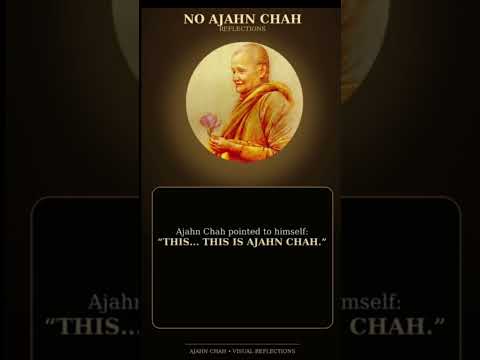
In this silent visual reflection, a layman approaches Ajahn Chah and asks, “Who is Ajahn Chah?” Seeing that the man is not yet ready for a deeper understanding, Ajahn Chah points to himself and says, “This… this is Ajahn Chah.”
Later, another person asks the same question. This time, Ajahn Chah recognizes that the questioner may be able to understand something beyond the ordinary idea of personal identity. His answer is simple, direct, and profound:
“Ajahn Chah? There is no Ajahn Chah.”
These words do not deny the conventional person known as Ajahn Chah. Rather, they point beyond the name, body, personality, memories, and social identity that we habitually take to be a permanent self. In daily life, names are necessary. We use them to communicate and identify one another. But when examined deeply, no fixed and independent person can be found.
The body changes. Feelings change. Perceptions, thoughts, moods, and consciousness continually arise and pass away. What we call a person is a changing process rather than a permanent owner or unchanging essence.
Ajahn Chah often taught through short statements that caused people to look directly into their own experience. His teaching was not meant only for intellectual discussion. It was an invitation to observe: What exactly do we call “me”? Is the body truly mine? Can thoughts be controlled? Are feelings permanent? Where is the unchanging self?
This visual Short is based on the opening reflection from No Ajahn Chah – Reflections, a collection of teachings presenting Ajahn Chah’s practical wisdom on meditation, impermanence, suffering, letting go, and non-self.
There is no spoken narration in this video. The teaching is presented through gentle visuals, music, and on-screen text, allowing space for quiet contemplation.
Pause for a moment and ask yourself:
Who am I beneath the name, the body, the memories, and the story?